Sunday, January 29, 2012

Gardening


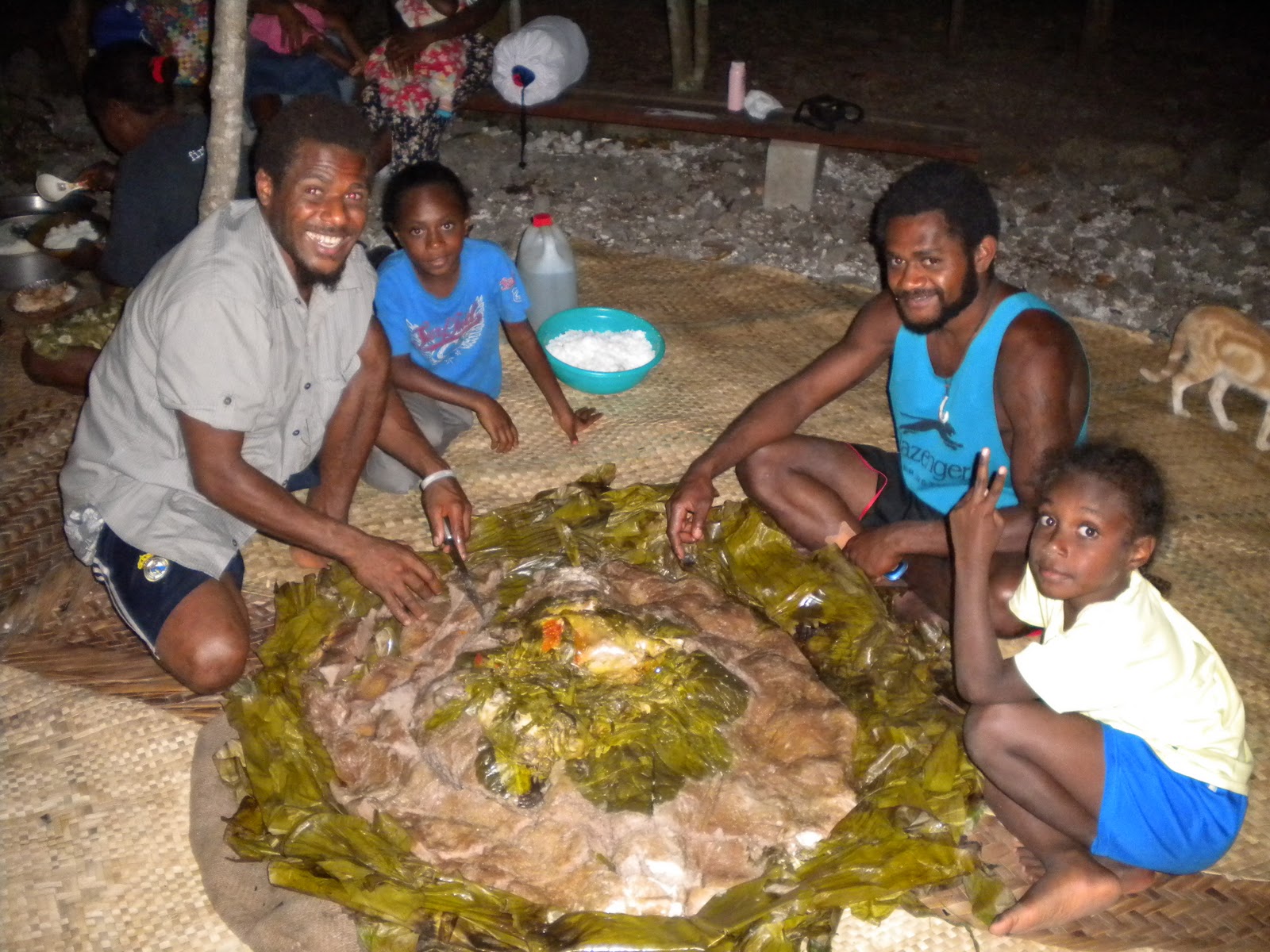
I have begun working on my garden, which has proven to be more of a project than I've anticipated. After the last volunteer at my site left, a tremendous amount of weeds invaded my back yard. Eradicating them has taken several days, but is almost completed now. I was delighted to learn that two pineapple trees are growing there (see top photo), since the pineapple here is the best I have ever had. I will never purchase canned pineapple again after this experience! The ground here is incredibly fertile. I have heard stories of volunteers tossing seeds out their windows and they grow. Rainfall also consistently falls for short periods every day, eliminating the need for watering the crops. Also growing are papaya, island cabbage, and nalailas, the green vegetable I ate with the su-sor (see bottom photo).  I plan to grow eggplant, sweet potato, avocado, garlic, ginger, green peppers, and tomatoes. The women in my host family have been extremely helpful in the weeding process. The men, however, have not. This is common in Vanuatu. Women are forced to conduct much, if not most, of the work while men are lackadaisical. Vanuatu has very little of a women's rights movement at this time, but my hope is that the influence of the Peace Corps will change this.

Coconut Wireless

This week I also attended a more traditional wedding than the previous one I attended. It included an exchange of gifts of mats, meat, and money between the families of the bride and groom. It began with Christian prayers and I was asked to offer a Buddhist prayer. I chose the Turning to the Tathagatha prayer, a prayer that beseeches the Lord of Compassion within all beings to bless us with awakening and loving-kindness. Since it was situated in the Presbyterian side of my village, it also included indulging in kava and tobacco. Being in my village is reminiscent of Prohibition to me, a time when people had to escape to dangerous, Mafia-infested neighborhoods in order to indulge in alcohol, since I cannot consume or purchase kava in the Seventh-Day Adventist community in which I am situated. I have heard stories of a Mafia presence in Vanuatu as well: From China. Mostly in the political and economic capital of Port Vila, I have heard many stories of the Chinese Mafia attacking anyone who competes with their business interests. The supermarket chain Au Bon Marché, despite its French name, is supposedly run by Chinese mobsters who will break the legs of anyone who tries to compete with them. I have also heard of a secret prostitution rink being run by a group of Ni-Vanuatu women who sell fruit, fish, and other produce in markets known as “mamas markets.” (Sometimes even bats are killed and sold there for human consumption, which is considered a Melanesian delicacy.) All these stories circulate the country through a gossip network between islands and villages known as “coconut wireless.” Nothing is too mundane, too scandalous, too petty, or too private to flow through this network, and Peace Corps Volunteers are prime targets, since we are essentially celebrities here. Whenever I do drink alcohol or kava (which is infrequent these days), I find the knowledge of it spreads like wildfire and becomes the latest village gossip. Everyone asks me how much I've had and how inebriated I've become. I find it somewhat invasive and judgmental. Even though nobody outright tells me not to engage in any activity, I find myself wanting to tell them, “I'm an adult. That's none of your business.” However, in Vanuatu, everything is their business if it spreads through coconut wireless. Some of what is included in coconut wireless is not even accurate, and discerning fact from fiction is not always easy. One Volunteer suffered the scandal of a false rumor that he was the father of an illegitimate child about to born to his community. Now I know how celebrities in American tabloids feel!

Birthday Su-Sor


Two children's birthdays were celebrated last week with two different cakes and a dish that is unique to Malekula: Su-sor. Su-sor entails cooking mashed yams within banana leaves over an open flame with hot stones and green vegetables called nalailas. After the yams are cooked, coconut milk is squeezed over the hot stones and the greens. Small strips of yam are dipped into the coconut milk and eaten with the hands. I made me realize how resourceful the people of Vanuatu truly are and what they can create with very little tools at their disposal. I found it very difficult to believe that it was accomplished without the help of any real modern technology. I also enjoyed eating with my hands—except for the sticky quality of the su-sor I was left with after eating it. Eating with one's hands is also the custom in India, where I lived for six months in 2006, so I surprised everyone by being accustomed to it. My favorite part, however, was the nalailas soaked in coconut milk, and was delighted to learn it is growing in my garden.

Friday, January 6, 2012

A Malekula Wedding


Last week I attended my first wedding in Vanuatu. In many ways, it was similar to an American wedding. The bride and groom were dressed in formal wear, while most of the guests were wearing casual clothes. I thought about how much less I concern myself with my attire now that I've come to Vanuatu. My former life in New York City had me constantly worried about my appearance and what others might be thinking and judging about my clothes for that day. In Vanuatu, men wear old T-shirts with gigantic holes. While women are expected to dress modestly, but it is rare for them to dress formally. It seemed to me that the couple already had three children, which is not uncommon in Vanuatu. Many couples beget children before marrying here. We ended with a cake not dissimilar to an American wedding cake and purely Ni-Vanuatu New Year's tradition: Sprinkling baby powder on our hair.

Flowers On the Water for New Years

For New Year's Eve, everyone in my community gathered at one of the local churches for a special service. After singing various church hymns in English and the usual sermon that instructed the congregation to turn to Jesus as their savior, we observed the New Years tradition of dropping flowers into the ocean at sunset. It reminded me of my time in India on the River Ganges in which we placed candles on the water while sailing at sunset. We said goodbye to 2011 and welcomed 2012. As the sun descended on 2012, I wondered how much the new year would impact my village, where very little seems to change day to day. However, perhaps my presence in the village will initiate changes that nobody there, myself included, will anticipate.

Tuesday, December 27, 2011

Family Day


Yesterday my host family celebrated Family Day, a national holiday that falls on the day after Christmas every year in Vanuatu. My host family caught fresh fish and celebrated my arrival in Vanuatu with a prayer and welcoming speech in Bislama. The people here have embraced me and the presence of the Peace Corps and proven themselves to be a culture based on hospitality and community. However, they are also limited and isolated by their geographic position as an archipelago with significant distance from any other nation, as well as their lack of media. People will ask me the same questions repeatedly, as well as questions with obvious answers. I will go to the beach and someone will ask me "Paz, yu go swim?" When I come back from the beach, the same people will ask me if I have just come from the beach. I believe this is because their lack of resources presents them with a scarcity of conversation topics. It is the same reason church sermons are recycled every Sunday. However, I believe the presence of the Peace Corps in the country will allow the locals to witness new information and ideas. Perhaps this is the reason the people of Vanuatu have always welcomed the Peace Corps. They are a culture in search of innovation, new dialogues that will enhance their quality of life.

Sunday, December 18, 2011

The Long Road From Lakatoro


Yesterday I needed to run errands that required a trip to the provincial center and main city on Malekula, Lakatoro. I needed to purchase some supplies for my new house, such as cooking tools and an aircard for Internet access. I also visited the post office and was pleasantly surprised when I offered 100 vatu as a tip for maintaining my mail and was declined. I thought, the Peace Corps must be held in high esteem in Vanuatu if the post office is willing to maintain a mail box for me without any compensation. Since I also have free access to the solar power at my school in order to charge my cell phone and computer while most people are charged a small fee, this to me is the most authentic indication that the Peace Corps is conducting worthy and productive projects here. While I was able to purchase many products I needed, I was not able to locate everything. The main disappointment was the aircard. I walked into an outlet owned by Digicell, the main phone and Internet provider in Vanuatu, and was told they did not have an aircard and sent me to another store. When I went to that store, I was told to try somewhere else. This kept happening until I decided I was too tired carrying many heavy cooking supplies to keep running around Lakatoro in search of an aircard. I walked back to Digicell and asked them to order an aircard for me and call me when it arrived. They said they would, but I do not feel confident this will actually happen soon, if at all. For now, I will be forced to come into Lakatoro and use the Internet at my friend's site. The ride back to my village was both beautiful and wasteful. I saw many variegated birds and trees and even a flying fox. However, the driver made several detours with no apparent purpose behind them. He drove us all around Lakatoro and, after leaving Lakatoro, through a forest outside my village. The ride took about an hour and a half longer as a result. While the scenery was breathtaking and left me wishing I had brought my camera, it was also an enormous waste of gas and time. I was tempted not to pay the driver, thinking a New York cab driver would have been discharged for such a ridiculous lack of professionalism and concern for our planet. Then, I remembered that this sort of thing is much more acceptable in Vanuatu than in the United States, and I did pay him. I came off the truck dizzy and in pain from sitting on the back of a truck for hours. I realized the urgent need for an environmental movement in Vanuatu that educates people about such the dangers of such prevalent practices as burning garbage, wasting fuel, and powering their houses with generators. Perhaps this will be my next project here as an educator.